How Does Our Nervous System Learn?
Insights and practical knowledge on how the nervous system’s learning process can be recalibrated

Our nervous system does not learn from thoughts, but from how a given chemical state becomes associated with environmental meaning. What we experience today as stress or calm is often not a matter of conscious choice, but the expression of a chemical language learned long ago. It may be that you are not “reacting incorrectly” to the world, but responding exactly as your nervous system has learned to do.
This learning process already begins during the fetal stage of life. At this time, the developing nervous system starts to associate internal chemical states with what it perceives from the environment: safety, stress, readiness, or calm. From these early patterns, a primary “internal vocabulary” is formed, which later determines what we perceive as threatening, soothing, or overwhelming as children or adults—often even when we can find no conscious explanation for these reactions.
This learning process does not stop later on.
Not in childhood, and not in adulthood.
Throughout our entire lives, the nervous system remains capable of refining and recalibrating this chemical language, even though its “basic vocabulary,” established in the early years, becomes deeply embedded.
This post explores how the nervous system learns across different stages of development, and how, in adulthood, it is able to form new meanings slowly but in a lasting way.
How Does the Nervous System Learn from the Fetal Stage to Young Adulthood?
The learning of the nervous system does not begin at birth.
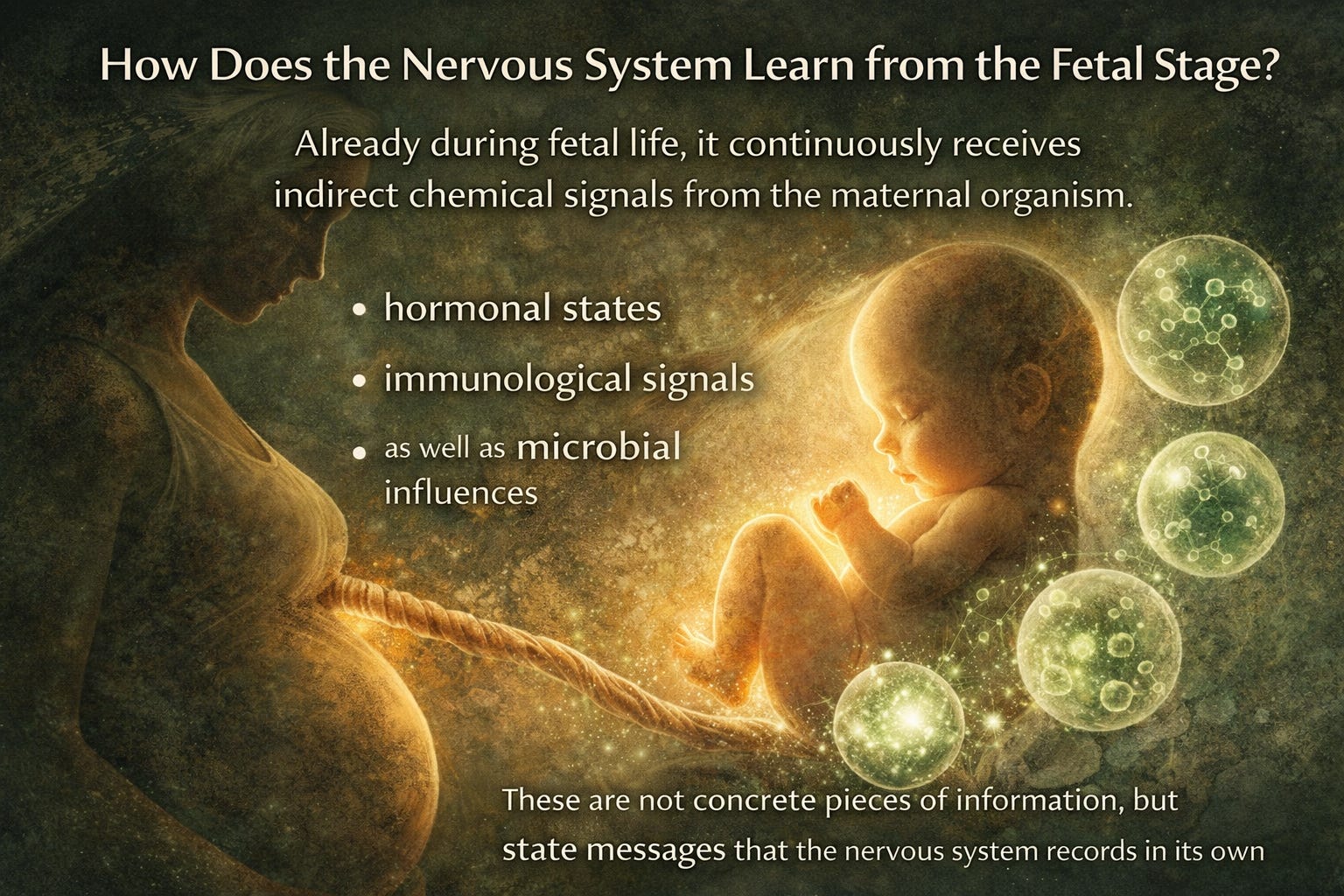
Already during fetal life, it continuously receives indirect chemical signals from the maternal organism.
These include, for example:
hormonal states,
immunological signals,
as well as microbial influences.
These are not concrete pieces of information, but state messages that the nervous system records in its own “interpretive dictionary.”
Broadly speaking, the learning process unfolds as follows:
1. State Recognition
The developing nervous system learns which states are associated with a given chemical pattern:
calm,
stress,
safety,
or readiness.
This is not yet emotion and not thought, but biological meaning-making.
2. Repetition and Feedback
The effects of neurotransmitters become “understandable” to the nervous system when they are linked to repeated environmental patterns.
Neurotransmitters are small chemical messengers in the brain that transmit signals between nerve cells.
They make it possible for us to think, feel, move, and respond to the world.
For example:
if a certain serotonin level is regularly associated with a calm, orderly environment, the nervous system encodes this pattern as safe.
Later, even smaller cues may be sufficient to evoke the same state.
3. Errors and Corrections
Learning in the nervous system is not linear.
In the beginning, it often:
overreacts,
or underreacts.
The essence of learning is not the avoidance of errors, but the possibility of correction.
A key role in this process is played by:
microglia,
as well as the immune system,
which help determine:
which neural connections should be strengthened,
which should weaken,
and which responses prove useful in the long term.
Fortunately, this fine-tuning process continues throughout our entire lives.
4. The Role of an Appropriate Learning Environment
The nervous system learns its chemical language most effectively in a varied but safe environment.
If the environment is too stimulus-poor:
the system does not learn to differentiate,
it may become hypersensitive,
or remain in a constant state of readiness.
If it is too chaotic:
stable meanings cannot be formed,
too many signals become associated with danger.
The nervous system does not learn best at extremes, but along the middle path.
How Does the Nervous System Learn in Adulthood?
Learning does not cease, but its mode changes.
In adulthood:
there is no rapid reprogramming,
instead, slow recalibration takes place.
This is why:
some situations trigger stress “for no apparent reason,”
others are calming,
and certain bodily sensations automatically elicit responses.
These are not irrational reactions, but the expression of old chemical meanings appearing in new contexts.
How Can the Chemical Language Be Recalibrated in Adulthood?
1. Repetition Alone Is Not Enough
The nervous system does not learn from single experiences.
No lasting change occurs simply because:
we calm down once,
sleep well once,
or go out into nature once.
Change happens when the same state is repeatedly paired with the same chemical pattern.
This is like a mislearned accent:
it is not corrected directly, but rewritten through hundreds of new sentences.
2. The Key Role of Feedback
After every reaction, the nervous system “asks the question”:
Did this response help, or not?
If a stress response:
does not lead to a real solution,
is not followed by calm,
does not resolve,
then the system does not learn from it—it simply repeats it.
Learning does not occur at the peak, but in the transition:
tension → easing
activity → rest
attention → release
This is where new meaning is formed.
What Most Disrupts This Learning Process in Modern Life?
1. Too Many Stimuli, Too Little Closure
Modern life is not overwhelming because it is stressful, but because it does not allow stress to resolve.
notifications,
constant readiness,
fragmented attention,
artificial light.
It is as if a sentence never receives its final period.
2. Sterile Environments = Poor Learning Material
Modern environments:
reduce microbial diversity,
simplify sensory input,
sterilize immune feedback.
This does not bring calm, but uncertainty.
The system no longer knows what is normal.
3. The “Everything Is in the Mind” Narrative
One of the most harmful assumptions is:
“If you are not well, it is a problem of your thinking.”
The nervous system does not learn from thoughts alone.
It requires biological feedback.
Summary
The chemical language of the nervous system is learned through repetition, closure, and real bodily feedback.
Rapid change cannot be expected through willpower alone, nor can we rely on perfect control.
Recalibrating the nervous system is a slow process, one in which nothing is erased and forced regulation does not work.
What does work is creating context, repetition with proper closure, and the body’s genuine return to a lower state of readiness.
The goal is not to become someone else, but to add new meanings to what the nervous system has already learned.
📚 Selected Scientific References
Foundational neurobiology & learning
Kandel, E. R., Koester, J. D., Mack, S. H., & Siegelbaum, S. A. (2021).
Principles of Neural Science (6th ed.). McGraw-Hill.
→ Az idegrendszeri tanulás, szinaptikus plaszticitás és fejlődési mechanizmusok alapműve.Bear, M. F., Connors, B. W., & Paradiso, M. A. (2020).
Neuroscience: Exploring the Brain (4th ed.). Wolters Kluwer.
Developmental programming & early-life influences
Meaney, M. J., & Szyf, M. (2005).
Environmental programming of stress responses through DNA methylation.
Dialogues in Clinical Neuroscience, 7(2), 103–123.Monk, C., Spicer, J., & Champagne, F. A. (2012).
Linking prenatal maternal adversity to developmental outcomes in infants.
Development and Psychopathology, 24(4), 1307–1324.
Neurotransmitters, state learning & feedback
Dayan, P., & Berridge, K. C. (2014).
Model-based and model-free Pavlovian reward learning.
Biological Psychiatry, 76(5), 375–382.Schultz, W. (2016).
Dopamine reward prediction error coding.
Dialogues in Clinical Neuroscience, 18(1), 23–32.
Microglia, immune system & synaptic refinement
Paolicelli, R. C., et al. (2011).
Synaptic pruning by microglia is necessary for normal brain development.
Science, 333(6048), 1456–1458.Stevens, B., et al. (2007).
The classical complement cascade mediates CNS synapse elimination.
Cell, 131(6), 1164–1178.
Allostasis, stress & recalibration
McEwen, B. S., & Wingfield, J. C. (2003).
The concept of allostasis in biology and biomedicine.
Hormones and Behavior, 43(1), 2–15.Sterling, P. (2012).
Allostasis: A model of predictive regulation.
Physiology & Behavior, 106(1), 5–15.
Adult neuroplasticity & slow recalibration
Draganski, B., et al. (2004).
Neuroplasticity: Changes in grey matter induced by training.
Nature, 427, 311–312.Kolb, B., & Gibb, R. (2011).
Brain plasticity and behaviour in the developing brain.
Journal of the Canadian Academy of Child and Adolescent Psychiatry, 20(4), 265–276.
Embodiment, bodily feedback & learning
Damasio, A. (2018).
The Strange Order of Things: Life, Feeling, and the Making of Cultures. Pantheon Books.Barrett, L. F. (2017).
How Emotions Are Made: The Secret Life of the Brain. Houghton Mifflin Harcourt.
Modern environments & sensory overload
Sandi, C. (2013).
Stress and cognition.
Wiley Interdisciplinary Reviews: Cognitive Science, 4(3), 245–261.Irwin, M. R., & Cole, S. W. (2011).
Reciprocal regulation of the neural and innate immune systems.
Nature Reviews Immunology, 11(9), 625–632.
God forbids our mistakes and sins, unfortunately our nervous system does it never🙏